Showing posts with label headphones. Show all posts

25 November 2012

6DJ8 Tube Headphone Amp

We are always on the lookout for good headphone amplifiers and here is a great simple tube design that will work with a wide range of headphones.  This tube headphone amplifier design comes to us from Bruce Heran.  The tube headphone amplifier is designed along the lines of the Oddwatt power amplifiers with the exception that this headamp does not require a driver stage. The headphone amplifier uses only one 6DJ8 tube per channel in a push-pull configuration.  All the circuit gain is in the single output stage. A constant current source (CCS) is used on the cathodes to force class-A operation. The headphone amplifier circuit has no coupling capacitors and no feedback loops.  There are a total of only 7 components including the tube in each channel.  The output stage is transformer coupled and the two transformer choices will accommodate most headphones with an impedance between 32 and 600 ohms.

6DJ8 (ECC88) Valve Headphone Amplifier - Inside
6DJ8 (ECC88) Tube Headphone Amplifier - Finished
The frequency response at the 50 mW level is from 20 Hz to 28 kHz within 0.5 dB and the wide band signal-to-noise is at -84 dB. Power consumption of the headphone amplifier is approximately 20 Watts (W).  Bruce reports excellent results with his Koss Pro4AAT (250 ohms) and Sennheiser HD-280 PRO (64 ohms) headphones.  "there was no audible noise or hum and the response was rich and clean"  For full project details, see the DIY 6DJ8 (ECC88) Tube Hi-Fi Headphone Amplifier Project page.

More DIY Headphone Amplifier Projects:

12 November 2010

Oatley K272A Head Amp audioXpress Review

The December 2010 issue of audioXpress magazine includes a review of the $30AU Oatley Electronics K272A tube based Headphone Amplifier Kit.  Mark Houston completed a review of the Oatley Electronics K272 Headphone Amplifier Kit in August 2009 and since then many hobbyists have enjoyed this inexpensive audio kit.  The hybrid headphone amplifier kit uses 6418 sub-miniature vacuum tubes and a headphone driver integrated circuit (PT2308).  Adding appeal to the tube based kit is battery operation. 


Highlights from the audioXpress Reliable Review of the Oatley Electronics K272A Headphone Amp by Aren van Waarde.

"Oatley Electronics (www.oatleyelectronics.com), which sells electronic parts and used equipment in New South Wales (Australia), has launched a small range of audio kits based on tube technology.  My interest was raised by glowing reviews written by Mark Houston, ..."

 "My initial impression of the sound of the K272A: warm, pleasant, and detailed.  Organ music sounded great."

"... the K272A/Grado combination produced excellent sound: a fne bass (powerful and deep but not overblown), detailed mid-range, sweet top-end.  Tonal colors of string instruments and vocals of male and female soloists were naturally represented. Many small, previously unnoticed details of recordings were revealed."

"In direct A/B comparisons, the K272A sounded better than the G4OEP (3/08 aX, p. 36) and even slightly better than the Stor class A amplifier (6/03 aX, p. 30)."

"For the asking price of 30 Australian dollars, the K272A is an absolute bargain.  And it does not involve any dangerous voltages."

The full review of the Oatley Electronics K272A Headphone Amp is available as a direct download from audioXpress [PDF- 737kB].


Additional Oatley Electronics Audio Kit Information:

What's Playing: Clannad - Macalla

12 April 2010

Hybrid Headphone Amp - 12AU7 Tube / IRF510 MOSFET


Rogers has improved upon his 12AU7 (ECC82) Tube / IRF612 MOSFET Headphone Amplifier project from August 2008 with a new version, the NP-100v12, a DIY 12AU7 (ECC82) Tube / IRF510 MOSFET Headphone Amplifier.  The 12AU7 / IRF510 headphone amplifier is powered from a rechargeable 12V sealed lead acid (SLA) battery which makes this an ideal project for novice builders as they don't have to worry about the high voltages typically associated with vacuum tubes.  The headphone amplifier circuit is very similar to the previous build utilizing a  single 12AU7 (ECC82) vacuum tube for the voltage gain stage which is followed by a IRF510 MOSFET follower stage which supplies current to drive demanding headphones.  IRF610, IRF611 or IRF612 MOSFETs will also work in this circuit.  The main difference between the updated headamp and the the original version is that a LM317 regulator (used as a constant current source (CCS)) is used in place of the load resistor to bias the MOSFET follower into class-A operation.

12AU7 Valve / IRF510 Mosfet with LM317 CCS Headphone Amplifier
12AU7 Tube / IRF510 MOSFET Headphone Amplifier
Included in the project documentation are printed circuit board (PCB) images and Eagle circuit board files so builders can easily make their own PCB for this project.  Being a fairly simple circuit, one could also easily build the headphone amp point-to-point on a 750 hole protoboard.  This simple headphone amplifier can be built for about $40-50 or less if you recycle parts and and enclosure.  For full details of this headphone amplifier, see the NP-100v12: DIY 12AU7 (ECC82) Tube / IRF510 MOSFET Headphone Amplifier project page.

More DIY Headphone Amplifier Projects:

What's Playing: The Beatles - Love

05 September 2009

High-End Audiophile Headphone Amplifier

Kelvyn Shaw in the UK sent us a note with a link to his latest DIY Audio Project - a High-End Headphone Amplifier. The headphone amp is made using only premium components and built around the National Semiconductor LME49710 high-performance Hi-Fi operational amplifier which is noted as costing 20 times more than your typical op-amp.

DIY High-End Headphone Amplifier PCB
LME49710 Headphone Amplifier
Kelvyn notes that the amplifier "Uses only the finest audiophile quality components that have been carefully selected with no expense spared". Power is supplied through a regulated dual rail power supply using a low noise toroidal transformer. The amplifier is housed in a black anodized aluminum enclosure with a heavy duty clear anodized aluminum front panel. An Alps Blue Velvet potentiometer is used for the volume control.
DIY High-End Headphone Amplifier
LME49710 Headphone Amplifier
DIY Audiophile Headphone Amplifier
Finished LME49710 Headphone Amplifier
From the BOM, the cost of the headphone amplifier is about £163 which is about $265US (4 Sept 2009). This is an advanced DIY project but for those who are are to the challenge, all the necessary information (schematic, BOM, PCB gerber data and enclosure panel drawings) to build one for yourself is available from Kelvyn's website KS Projects - Headphone Amplifier along with several construction photos. Nice work and enjoy your headamp.

More DIY Headphone Amplifier Projects:

What's Playing: Joni Mitchell - Wild Things Run Fast

24 August 2009

6418 Sub-miniature Tube Preamp / Headphone Amp

We often get questions asking about suitable vacuum tube (valve) kits for beginners or first time DIYers. Aside from the fact that vacuum tube audio kits are generally expensive, there is also the safety concern that most tube circuits operate with potentially lethal voltages. Mark in Australia found the following 6418 tube preamplifier and headphone amp kit which is an exception - it is inexpensive and can operate from single 9V battery.

6418 sub-mini Tube Preamp / Head Amp Kit
The tube preamp / headamp kit is from Oatley Electronics in New South Wales Australia and based around the Raytheon JAN6418 sub-miniature valve (tube) and an IC. The K272 Stereo Tube Preamplifier – Headphone Driver kit cost $27AU (~$23US – August 2009). The kit is complete including a printed circuit board (PCB) which makes for easy assembly but you will need to provide your own enclosure. The kit only consumes about 12mA at 9V and can be powered with a single 9V battery making this a safe and ideal kit for those who are new to vacuum tube electronics.

6418 Tube Preamp / Headphone Amp Kit

The photo above is a build of the kit using the supplied parts. Since the 6418 tube are extremely microphonic and will "ring" if they are subjected to vibrations rubber grommets are used to help damp the tubes. Mark has built a number of these kits now including a few with upgraded parts (metal film resistors, polypropylene film inter-stage capacitors and a Burr-Brown OPA2134 op-amp). The photo below is a tube preamp in a plastic ABS enclosure using the kit and upgraded components.

6418 Tube Preamplifier Kit
Mark reports that the kit performs well and sounds good. The bandwidth is very wide, the -3dB points are 10Hz and 50kHz. As a preamp there is good depth, wide breadth and sharp detail revealing fine recorded detail with no hard edges. The photo below shows the kit in a plastic enclosure being used as a portable headphone amplifier.

6418 Tube Headphone Amplifier Kit

The tube preamp / headamp kit from Oatley Electronics is well worth the $27AU price tag. For complete project details and more variations see the project page for the 6418 Tube (valve) Preamplifier / Headphone Amp Kit.

Additional Tube Headphone Amplifier Projects:


What's Playing
: Roy Orbison - Shahdaroba

05 August 2008

Hybrid (12AU7 / IRF612) Headphone Amplifier

Over the past few years, headphones have come long a long way. For $70 to $150 you can get a great sounding pair of headphones. Best of all, headphones allow you to get right into the music anywhere you are and you do not have to worry about annoying things like room modes and reflections. And for you do-it-yourself (DIY) audiophiles, there are also a number of great DIY headphone amplifier projects that you can choose from. Here are the details for Rogers' low voltage 12AU7 tube hybrid headphone amp.
12AU7 Tube / IRF612 Mosfet Headphone Amp
Vacuum Tube / Mosfet Hybrid Headphone Amp
Rogers has put together a very simple hybrid headphone amplifier for use with 32 ohm Grado SR125 headphones. His hybrid head amp uses a vacuum tube voltage gain stage which feeds a MOSFET follower output stage. The tube is a the 12AU7 (ECC82) and the MOSFET is an inexpensive IRF612. The IRF612 is configured in a typical single-ended class A circuit using a passive constant current source (CCS).

What's best about this project is the power supply.
Both the 12AU7 tube and IRF612 MOSFET are set up to operate at low voltage (~12-13V). Power for this project is supplied via an external switch mode power supply (SMPS). All of the project parts are readily available and one can easily put together one about $40. Rogers has reported very good results from this very simple project. For full project details, see the 12AU7 Tube / IRF612 MOSFET Hybrid Headphone Amplifier Project.

Related Posts:

What's Playing: Tom Petty - Wild Flowers

30 June 2008

DIY Class A Headphone Amplifier

The computer sound card just didn't cut it when it came to driving my 32 ohm Grado SR80 headphones, so the need arose for a decent desktop headphone amplifier. Lately I have been reading a lot about Class A amplifiers and have been eager to try one, so a small and simple Class A headamp seemed like a logical first step in this direction.


The circuit is a simple single-ended amplifier with an active load. An inexpensive IRF610 MOSFET is used as the output device and a LM317 voltage regulator is configured as a constant current source (CCS). The power supply is a regulated wall wart which works very well and there is no hum. For the enclosure I used a dead external CD-ROM. This worked out very well as it will reside on my desk at work. I'm sure everyone will be wondering why I have an old external CD-ROM hooked up to a new laptop!


The results were very good. Despite the simplicity of the amplifier circuit it sounds surprisingly good. For more details, photos and a schematic, see the DIY IRF610 MOSFET Class A Headphone Amplifier Project page.

Related Posts:

What's Playing: The Farrell Bros. - Career Opportunities

27 November 2007

CMoy / Grado RA-1 Headphone Amplifier

Mark is keeping busy on the hobby front and has completed another DIY Audio Project, a battery powered headphone amplifier. His DIY headphone amplifier follows the idea of the very popular CMoy headphone amp which is a basic non-inverting amplifier using an operational amplifier (op-amp). The amplifier circuit is contained on a basic IC protoboard, uses the Burr-Brown OPA2134PA op-amp and is powered by two 9-volt batteries.

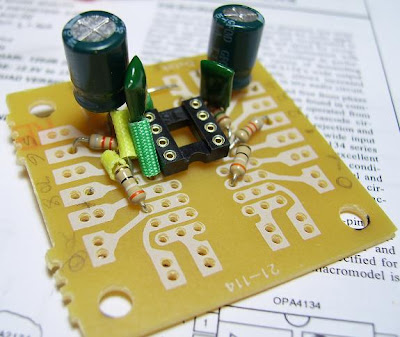
CMoy Headphone Amplifier on Protoboard
The idea to house the DIY Headphone Amplifier in a wooden enclosure was taken from the Grado RA1 headphone amplifier which is contained in a beautiful mahogany box.

CMoy Headphone Amp in Wooden Enclosure
Mark is very pleased with the performance of this simple and inexpensive headphone amplifier project. For full details, including additional pictures and the schematic, see the DIY CMoy / Grado RA-1 Headphone Amplifier Project page.


Related Posts:

What's Playing: Burton Cummings - Sour Suite (live)

13 August 2007

Grado RA1 Headphone Amplifier

A while back I got the headphone bug and purchased a pair of Grado SR80 headphones [new model: SR80i]. I am very pleased with the inexpensive ($99US) headphones which deliver great value.  The Grado SR80 headphones have an impedance of 32 ohms, so I built a CMoy Headphone Amplifier in an Altoids mint tin to drive the somewhat demanding headphones. The results were surprisingly good, especially when you consider that one can easily build a CMoy Head Amp for about $20. The CMoy was a huge improvement to a portable media player and rivals the performance of the built-in headphone amplifiers on NAD C162 and NAD 1020 preamplifiers.
A while back, I was showing off the Grado SR80 headphone / CMoy combination to a good friend. He is the Walkman, Discman and now iPod type who typically lives with the factory supplied headphones until they die, replacing them with similar light travel headphones. He was stunned with the amazing sound quality, so I let him live with the Grado / CMoy combo for a while. Not surprising, he loved the sound quality, but found that the Grado headphones were too bulky and leaked too much sound for use on public transit.

While he found that the combo was not suitable for his daily commute, he was in love with the amazing sound quality and decided to spoil himself. He purchased a pair of Grado SR225 headphones and a Grado RA1 headphone amplifier for use at home.

For those of you who are not familiar with the Grado RA1 headphone amplifier, it is well regarded, runs off of two 9V batteries, is housed in a beautiful mahogany enclosure and retails for about $350US. A stock photograph the Grado RA1 is shown below.

Grado RA-1 Headphone Amplifier
Grado RA1 Headphone Amplifier

Recently I had the opportunity to visit and listen to his Grado SR225 / RA1 combination. Of course I brought along my little pocket CMoy headphone amplifier!


We both did some blind listening and in the end we pretty much had the same listening impressions. We thought that both the CMoy and RA1 amps sounded excellent and fairly similar, but we both gave a slight edge to the DIY CMoy amplifier. We were both a little surprised, considering you can build a CMoy for about $20 or buy an already built one for about $40 on eBay, yet the Grado RA1 rings in at $350.


After a few Google searches, we found that others had reported similar listening impressions between the two amps. That being, they both sound very good, with similarities between the two and the slight edge going to the CMoy.  


Dissected Grado RA1 Headphone Amplifier

But what I found most interesting were these two sites, one which showed the dissection of a Grado RA1 headphone amplifier and the other which also took apart and upgraded the Grado RA-1. The sites provide pictures of the inner details of the RA1 and also a schematic for the amplifier section.  The schematics below show the both the Grado RA-1 and CMoy headphone amplifiers.


Schematic - Grado RA1 Headphone Amplifier

Schematic - CMoy Headphone Amplifier
Both the Grado RA1 and CMoy designs use a basic non-inverting amplifier circuit using an operational amplifier (opamp).  For my CMoy, the opamp used was a OPA2132PA (Burr-Brown) which retails for about $5 and for the Grado RA1 uses a JR4556 that retails for about $0.50. Despite the fact that the JR4556 is a low cost opamp, the RA1 sounds decent, but not as good as a properly implemented CMoy headphone amplifier - (DIY lets you choose the gain setting).

Related Posts:

07 November 2006

CMoy Mint Tin Headphone Amplifier

Originally Posted: 21 June 2006
A while back I purchased a nice pair of cans ... Grado SR80 Headphones. When I bought them, I knew that they would drive me to build a DIY headphone amplifier. Well, here are the results ... A very simple CMoy mint tin headphone amplifier.

Grado SR80 Headphone and CMoy Amplifier
The CMoy is a very popular and easy to build headphone amplifier that can be fit into a mint tin. It can be used to drive demanding headphones, produce thunderous volumes and most importantly, it sounds excellent. The original article A Pocket Headphone Amplifier by Chu Moy discusses all the fine points of the amplifier, while How to Build the CMoy Pocket Amplifier provides excellent and easy to follow building instructions.
My version of the CMoy headphone amplifier uses two nine volt batteries, the OPA2132PA (Burr-Brown) operational amplifier (opamp) and I originally set the gain to 9 - which turned out to be far too high. I have since adjusted the gain down to about 3. Since I will be using this with a portable MP3 player, I elected not to include a potentiometer as the volume will be controlled through the MP3 player.

CMoy Headphone Amplifier in Altoids Mint Tin
The CMoy headphone amplifier sounds pretty darn good when you consider the simplicity and low cost. It provides excellent clarity, even at high volume. The headphone amplifier does not seem to add its own colorations to the sound and there is a lot of detail. The amplifier is very well behaved and there are no pops when powering up or hiss during operation. Overall, this is a very nice little performer and it considerably increases listening pleasure with a good set of headphones.
Related Posts:

What's Playing: Joy Division - She's Lost Control

06 November 2006

Grado SR80 Headphones

Originally Posted: 17 April 2006
After reading a few articles at the HeadWize forums, I got the headphone bug and figured I needed a new pair. I spent a little time researching headphones on the net, and the Grado line of headphones, particularly the SR60 and SR80 were getting good reviews relative to their cost..

Grado SR80 Headphones

So I went headed off to the local Hi-Fi shop and gave a few "cans" a good listen. I did not want to break the bank, so I concentrated on the Grado line of headphones. I listened to the SR60, SR80, SR125 and SR225. As one would expect, they generally got better as you moved up the line. The SR60s seems to have the best bass of the bunch, but seemed a little dry in the midrange. To my ears, the differences between the SR80 and the SR125/SR225 were subtle, so I went with the SR80. If you prefer music with more of a thump, the SR60 are an excellent choice and also the lowest cost of the bunch.

A comparison of the measured frequency response (by headphone.com) is shown in the plot below.
Grado SR60 / SR80 / SR125 / SR225 Headphone Frequency Response Plot
Related Posts:
What's Playing: Fleetwood Mac - Dreams