This is a project that sort of evolved from an interest to see how good a particular phonograph preamplifier was. Not the one I designed, but one from a DIY kit. If I would have known how difficult and possibly inconclusive it would become, I might have not done it. As it was, the experience was valuable in several ways. First let it be clear in everyone’s mind that this comparison is largely subjective and based on what I hear or can measure. It was concerned with only those preamps that I had available at the time and your thoughts and results could be quite different. The comparison demonstrated that without a top notch system nearly any preamp might be OK. The flip side was also true that in a top notch system, many preamps would be unacceptable. Another thing that came from the listening and testing is that compliance with RIAA equalization varies from company to company but in many cases might not be audible.
My method for comparison had two parts. The first was to listen to various selections of music with each preamp and then score them on various things I felt meaningful. The second was to check various parameters with my test gear. The following six phonograph preamps were the ones compared:
 |
Left top, Moon LP3, left middle TC 750, left bottom Jaycar KC5433,
Right top, Groove, right middle K303, right bottom DH101 |
General
The various phonograph preamps cover a wide range of designs and prices. The lowest cost ones are approximately $50 (TC750) and the most costly more than 10 times as much (LP3). One has an undetermined price at this time (Groove) and is likely to be above the upper end of the group even in kit form. Design variations range from entirely IC to all tube. Some use single ended configurations on the active devices, one uses fully complementary differential style (DH101) and one SRPP (Groove). All are designed as stand alone devices with the exception of the DH101 which is a complete preamp. All are MM/MI compatible with the LP3 also covering MC applications. All, but one, are solid state devices. There will be two phases, bench testing and listening.
Equipment Used For The Listening Portion
- Pro-ject Debut III turntable with acrylic platter and Speedbox
- Dynavector 10X5 high output MC cartridge (re-tipped with ruby cantilever by Sound Smith)
- 80-Step Passive preamp (1% precision resistors)
- Oddwatt KT88 Monoblock valve power amplifiers
- Martin Logan Vista electrostatic speakers (operating full range)
- Marchand electronic crossover (50 Hz low pass / 24 dB per octave to subs only)
- AudioSource Amp 100 dual 50 watt RMS solid state power amplifier (for the sub)
- Custom designed 7 cubic foot subwoofers, 15" drivers (F3 = 22 Hz)
- APC H10 AC line power conditioner
Listening Tests
Listening tests were performed first to avoid prejudging performance based on what the test measurements might indicate. Music selections consisted of new and older records. The music selected was varied and covered a wide range of genre. Different selections might have provided different results, but I tried to span a wide range. There were acoustic stringed instruments, male and female vocals (duets too), classic rock music, music with keyboards, solo jazz singers and big band. Each preamplifier was played in turn with the order mixed up with the same selection.
The listening performance was subjective and the various ratings are solely those of the tester. Scoring was as follows: Numeric grade of 1 to 10 with 10 being the best. 10 = among the best I have ever heard, 8 = excellent performance, 6 = average performance, 5 = minor deficiencies, below 5 increasing levels of unsatisfactory performance. Areas rated were: Signal to noise – both hum and / or background noise (only in bench testing unless one is obviously deficient during the listening tests), treble response, mid range response, base response, image centering, low level detail, sound stage width, and overall involvement of the sound.
 |
| (click to enlarge) |
 |
| (click to enlarge) |
 |
| (click to enlarge) |
Listening Test Results
It seems that price and to a certain degree complexity matters. The three most pricy or complex designs were clearly better than the lower cost three. All of the top three excelled in some areas. There is a different flavor to each that shows up in how they rendered the different musical tracks. The Groove was a clear standout in the bass region. Solid, deep and well controlled bass was noted in all cases. Other preamps occasionally got into the sub 50 Hertz range, but none with such authority. The LP3 was second in this area and was clean and well controlled, but not nearly as authoritative. The DH101 had deeper bass than the LP3, but it was not as clean and well controlled. At the opposite end of the range, the LP3 had a slight edge on all others in treble presentation. The Groove was a close second and often they were tied. In the areas of inner detail, imaging and sound stage width the differences were often linked to the particular music being reproduced. It was largely a toss up between the LP3 and Groove with the edge going to the Groove. The primary difference between the top two preamps is one of flavor. The LP3 has a crisp clean leaning toward neutral sound and the Groove a warmer more delicate sound. Either would be satisfactory in many systems. The DH101 fell slightly short of the performance of the top two, but was in most areas a rather nice sounding preamp. The three preamps in the “budget” category were sort of a mixed bunch. They clearly were in a different category from the top performers. In some cases they would be good entry level preamps for someone just starting in vinyl. The TC750 even with upgraded components was at the bottom of the group. It performed in what I would generally characterize as less than average manner. It really has no place in a quality system. The other two (Jaycar KC5433 and the K303) are fairly well matched. Each is slightly above the average level, but well short of the top performers. Generally their shortcomings were by omission and not commission. They are characterized by things such as less detail, less response in various parts of the spectrum and the like. They did exhibit some sibilants and edgy sounding behavior on various selections, but were mostly listenable. I felt that the level of listening involvement suffered from the omissions. I would not recommend them for use in systems above the rather modest level. It must be noted that the two are diy kit based and low cost and would not be expected to compete in the same arena as the top performers. For entry level systems they might be a reasonable option. The K303 has two gain options and the recommended setting (less gain) resulted in an output significantly below all the other preamps. I changed the setting to the higher level and the output them was approximately equal to the other preamps.
 |
| (click to enlarge) |
 |
| (click to enlarge) |
Equipment For The Bench Testing
- HP 331A distortion analyzer
- Velleman PCSD 1000 PC based digital storage oscilloscope
- Tenma digital storage oscilloscope
- Tenma precision signal generator
- Circuit Specialists MS8040 true RMS multi-meter
- B&K 290 electronic analog multi-meter
- APC H10 AC line power conditioner
Bench Testing
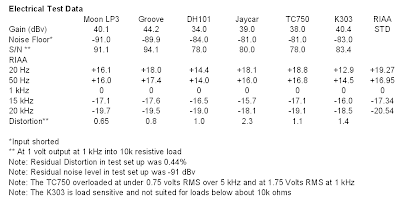
All six phonograph preamps were bench checked with my typical set up of equipment. My results may or may not agree with results by other individuals, but are consistent among themselves. A long standing issue in my workshop is a relatively high level of electronic noise. All my equipment is fitted into a fairly small area and a lot of it generates noise. The noise floor in the shop is typically -91 to -95 dBv. This necessarily limits my ability to test really quiet equipment. This was the case with two of the preamps. On the day of the tests the noise floor was -91 dBv. The Moon LP3 measured -91 dBv and the Groove at - 89.9. All those results can tell me is that both units are very quiet. The specification for the Moon is -106 dBv and the Groove has been previously measured consistently right at the noise floor (-90 to -91). The remaining 4 preamps did measure within the capability of my equipment. They ranged from as low as -81 dBv to a high of -84 dBv (more negative is better).
The gain of the preamps ranged from a low of 34 dBv (DH101) to 44.2 dBv (Groove). The remaining 4 units were all clustered around 40 dBv. Initially the K303 was about 2 dB lower than all the others (at an estimated 32 dB) and I made the kit indicated modification for additional gain. In my opinion the original gain would be insufficient for many systems especially those using passive preamps.
For signal to noise level I used a combination of the noise floor and the gain. It might be better called effective difference between the level of output and the noise floor for a given input signal. That way it would provide an indication of how quiet a preamp would seem in any particular system. The more output you have from a preamp the less follow on gain you will need to use for a comfortable listening level. Then turning down of the system gain will apparently lower the noise floor of the entire system. The opposite is equally valid. An apparently excellent noise floor could be offset by low gain with the result being an apparent higher overall noise level in the final sound level from the system. The results here favored the Groove with its higher gain; however the Moon would probably be better if the actual noise level could have been measured. Both are extremely quiet in use. The remaining units were within a 5 dB span with the DH101 with the lowest apparent signal to noise ratio. None however exhibited sufficient noise to detract from the listening experience.
Distortion levels were measured at 1000 Hertz at the 1 volt RMS level into a 10k-ohms resistive load. Capacitance was minimal at approximately 100pF due primarily to the short cables used in the test set up. Deviating from my usual procedures, I used a battery powered signal generator. This eliminated a number of possible noise sources that would be considered by my distortion analyzer as distortion. For it anything that is not the fundamental is considered distortion. The penalty in doing this is that the residual distortion in the generator was 0.44%. However, since all preamps were tested the same the results while not definitive do provide a comparison. It should be noted that doing a complete test of the distortion levels and subsequent matching to the RIAA standard is a very time consuming process and was not the focus of this comparison. The actual distortion levels ranged from 0.65% for the Moon to 2.3% for the Jaycar. As noted in the listening tests there were no specific instances of audible distortion, but rather some less than stellar performances. Of particular note were issues with the TC750. In testing it was discovered that it had a very low output capability. It was unable to deliver over 1.75 volts RMS at low to mid frequencies and above approximately 10 kHz it could not deliver over 0.5 volts RMS without visible distortion of the wave form. All other preamps were able to deliver over 5 volts output at any frequency easily.
To determine basic compliance with the RIAA standard, I used 5 separate frequencies. All preamps were tested at the one volt output level except the TC750 that was unable to deliver that level and it was tested at the 0.5 volt level. The chosen frequencies were picked as they are the ones where the worst performance could be expected. This is at the upper and lower extremes of the audio band in comparison to the 1000 Hertz reference. My experience has been that nearly any phono preamp can come reasonably close to the standard between the limits of 100 Hertz and 10,000 Hertz. There is some disparity in what various manufacturers do at frequencies below 50 Hertz and above 15,000 Hertz. Some either flatten the curves there or in some cases actually intentionally reduce response there. The thinking behind this is most likely that there is little musical content there and there are possible benefits to the signal to noise and cancellation of rumble and low frequency resonances. In my opinion, the preamplifier should reproduce whatever signal it is fed and problems with noise should be handled at the source. As noted in earlier paragraphs, the measurements I made might or might not be the same as someone else would get, but all units were tested the same and the results allow for some comparisons. There really was no perfect fit. However the Groove, Jaycar and (surprise) TC750 were closest. The Moon was excellent on the high end, but for some reason demonstrated a reduction at 50 Hertz (only a dB) and a rapid reduction in response at 20 Hertz (3 dB). The K303 was significantly off at 50 and 20 Hertz and I can speculate it was because of its high sensitivity to the load. This was evident when a quick check of each preamp was done with a 5 k-ohm load in place of the standard 10k one. The only preamp that demonstrated a significant drop in output was the K303. The reduction was approximately 3 dB at mid band. This factor may limit its application to only systems with relatively high input impedance (the test system was approximately 50 k-ohms).
 |
| Electrical Test Data (click to enlarge) |
|
Summary and Conclusions
Since the comparison was largely subjective with some bench testing used to verify or at least establish some relationships between the preamps, the conclusions necessarily are also subjective. None of the three “budget” preamps should be considered anything but entry level devices. The TC750 is at best a marginal one even in that group. The K303 and Jaycar are fairly well matched, but have slightly different sonic signatures. In modest and undemanding systems they would probably be adequate. I would not use the K303 without the modification for higher gain. The notation in its instructions that the extra gain would allow it to be used with low output moving coil cartridges is suspect. With the extra gain it was right in the middle of the group for moving magnet / moving iron cartridges. I would also not use it systems in which the following equipment had an impedance lower than 10K ohms and preferably with ones above 50K. The DH101 was a surprisingly good performer considering it was included primarily as a comparison of older technology, granted one with some exceptional design features. It would have fared better with more gain, but since it is actually part of a complete preamplifier it is entirely likely that the shortage in gain was compensated for in later stages. The remaining two preamps are both excellent and quite different in many respects. Both are extremely quiet. They have low distortion and with the exception of the curious bass reduction in the Moon, match the RIAA curves well. They both sound excellent, but different. The Moon is articulate and the Groove robust. Each is a product of its technology. The Moon is all solid state IC based. The Groove is an all valve design. The end choice is likely to be whether you prefer solid state sound or valve sound. I will not argue for either case as both are valid at the personal level. My personal preference is for the sound of the Groove, but I could, and have listened happily to the Moon for nearly a year while designing and perfecting the Groove.
Good listening,
Bruce Heran


