Showing posts with label cables. Show all posts

22 February 2012

DIY Shielded RCA Interconnect Cables

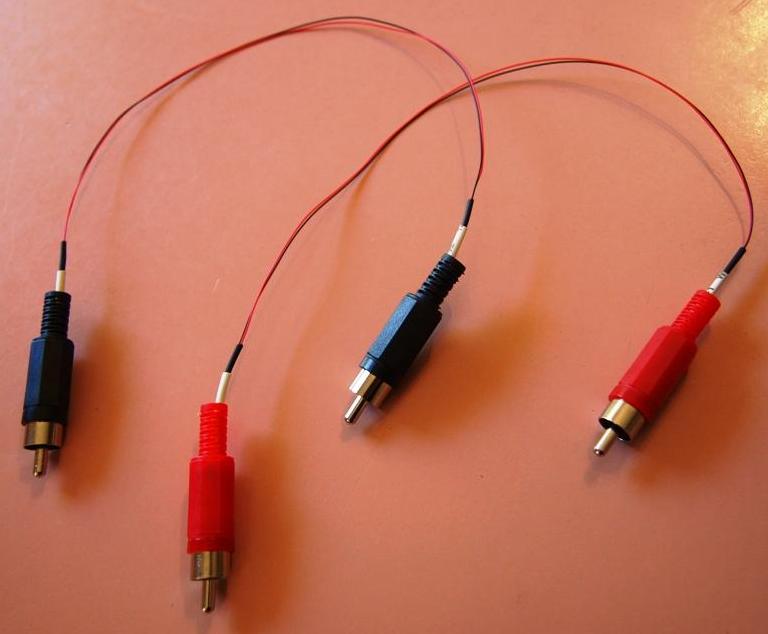
Tom has put together an easy to follow guide showing the construction of simple line-level RCA interconnect cables. The very simple cable recipe uses shielded instrument wire and good quality RCA plugs which you should be able to find at your local instrument shop.  Tom used Sommer SC-Tricone MKII wire and Rean RCA plugs, and you can use your favorite brands.  Tom's finished DIY shielded RCA interconnect cables are shown below. 

DIY Shielded RCA Interconnect Cables
The cables are very simple to construct requiring only basic soldering skills.  The required parts are easy to source and a pair of these shielded RCA cables can be built in about one hour and for as little as $10. Tom indicates that these simple DIY cables are a great upgrade over typical stock and other inexpensive interconnects.  See the project page, DIY Shielded RCA Interconnect Cables for full details.

More DIY Cable Projects

07 December 2010

The Fine Wire Audio Cable Shoot-Out

After finishing the SuperCables CookBook by Allen Wright I decided to make some audio cables.  One of the concepts that Allen pushes in the book is very thin wires.  Originally I had no intentions of making any cables from the book but after reading through the book I got the urge.  According to Allen thin is in.  I chose to try a couple of the designs that use wire wrap wire (WWW).  Details of the cables that were built using WWW are noted in Part 2 of the SuperCables CookBook review.

The HiFi Test Set-up
The test set-up used to evaluate the cables consisted of an upgraded Oppo 980H, a diy build of the Nelson Pass B1 buffer preamp, a diy 6AS7 SET power amplifier and Fostex FE206En drivers in a back loaded horn enclosure.  I selected a number of test tracks which I thought had enough variation to exhibit any great cable sonics.  To make sure I was not biased I enlisted the aid of a golden eared friend, Ron from the Melbourne Audio Club.  He also brought along his test tracks.

Oppo 980H, Pass B1 Buffer, 6AS7 SET, FE206En Rear Horn

Cable Shoot-Out
We played through about half a dozen test tracks using both short and long runs of #1, Air-spaced Finewire RCA cables and set of #6, Air-spaced Finewire speaker cables which were 2 m in length.  My SET amp produces only 3W so fine wire speaker cables will work with this amp.  But will it be the best sound we can get?

What we found was in just three test tracks we could listen for:
  • The shimmer in cymbals
  • The breathiness in flute and its balance against a harp
  • The rich tone of a fully fleshed violin
Of course this in no way covers every tone or nuance of every sonic effect listenable on any recording but I feel it was enough to highlight the main differences in the cables.

After listening with the cable combination above we swapped the #1, Air-spaced Finewire RCA cables for a cheap $2 store bought RCA cable.  Some areas of the test music actually improved.  The sound stage appeared to widen or was it just smeared between the speakers.  The violin appeared to fatten-up or was the detail just lost.  Ron and I then, cable by cable, started putting back both sets of #1, Air-spaced Finewire RCA cables and the other various cables that we had on hand.

We started with the short #1, Air-spaced Finewire RCA cables which lead from the CD player to the preamplifier.  We also introduced my twisted version of the WWW interconnect cables and also my braided Silver Highway RCA cables.  I have built many sets of these high-purity silver wire RCA cables and everyone who has used them claims they are excellent.  At each stage we re-listened to the three test tracks.

What We Found
Without boring the pants off you with every detailed cable swap this is what we found.
  • The #1, Air-spaced Finewire interconnect cables work best between the CD player and the preamp (short cable, 150 mm long)
  • My diy Silver Highway RCA cables (900 mm) worked best between the preamplifier and power amplifier.  They worked better than my twisted WWW cable, but only slightly better.
  • Multi-stand heavy OFC speaker leads (3 m long) with heavy brass banana plugs only just outperformed the #6, Air-spaced Finewire speaker cables (2 m long).
Cable Measurements
Ron brought his dedicated capacitance and inductance meter and here are the cable measurements:

RCA Cables
#1, Air-spaced Finewire (short):  30 pF,  8 uH,  0.4 ohm
#1, Air-spaced Finewire (long):  30 pF,  13 uH,  1.5 ohm
Twisted cables (destination end):  13 pF,  8 uH,  0.4 ohm
Twisted cables (source end):  138 pF,  10 uH,  0.4 ohm
Silver Highways (900 mm):  71 pF,  2 uH,  0.3 ohm
$2 Generic RCA (1000 mm):  370 pF,  0.1 uH,  0.1 ohm

Speaker Cables
#6, Air-spaced Finewire (2 m):  25 pF,  17 uH,  1.5 ohm
Multi-stand heavy OFC (3 m):  210pF,  1uH,  0.1 ohm

Note: The twisted cables comprise of three wire wrap wires, only two of which are terminated at the destination end.  I believe the 30 pF of capacitance for some of #1, Air-spaced Finewire cables is due to the cheap RCA plug that was used.  The twisted cables had only 13 pF for the destination end which only has two wires connected.  Also the RCA  used on the twisted cable were heavy weight high-end types and I believe low capacitance types.

Just a Cable Suggestion
It is worth while trying different cables, weather you make your own or buy them off the shelf.  If possible, try borrowing some friend’s cables before outlaying hundreds of dollars on expensive ones.  Different combinations of cables can work better than just one cable type used throughout your system.  If nothing else, cable swapping and comparison will fill in an afternoon and you may enjoy the music along the way.

Mark Houston - retro-thermionic
To email Mark, type out the email address.

This concludes Mark’s three part series of the SuperCables CookBook.  For the full story, refer to the SuperCables CookBook (Part 1) which reviews the book and Part 2 of the SuperCables CookBook review which takes a look at a couple of the cable recipes.

Update (11 December 2010): I've updated the terminations for both the #1, Air-spaced Finewire RCA interconnect cables and the #6, Air-spaced Finewire Speaker Cables.  See the Skinny is in! - Thin wire audio cables thread for more information and further discussion.

DIY Cable Projects

05 December 2010

SuperCables CookBook - Review (2/2)

A couple of days ago I posted a partial review of the SuperCables CookBook by Allen Wright.  Of course there is not much use in working your way through a audio cable design book and then not building at least one of the cable designs.  In this second part of the SuperCables CookBook review I will share my experience with a couple of the book designs and also try a simple design of my own using some of the design concepts outlined in the book.

Over the past few years I have built a number of diy twisted RCA interconnect cables using high purity silver wire.  Some of the cable design concepts outlined in the SuperCables CookBook agree with my past construction methods.  So, can I use the new concepts to build a better interconnect cable?  There are several cable designs in the book and I chose to build the wire wrap wire (WWW) interconnect and the WWW speaker cables.  Wire wrap wire is typically 30AWG silver plated copper wire often insulated with Teflon.  It is cautioned in the book that the WWW speaker cables can be no longer than 2m and that they should be used for low power amps only.  My axe-of-choice when it comes to power amps is a 3W 6AS7 based SET (Single-Ended Triode) amp.  Perfect.  The book also cautioned that if you use these light weight speaker cables, you must remove all heavy connectors.

 #1 Air-spaced Finewire RCA Interconnect Cables

Constructing DIY Audio Cables
For my HiFi setup I needed to construct at least two sets of RCA interconnect cables and one set of speaker cables.  For RCA interconnect cables I built three sets in total of two different designs.  Following the book design for #1, Air-spaced Finewire, I built two sets of wire, one very short set and one about 900 mm in length.  The third RCA cable set was built by applying some of the concepts I picked up from the book.  For the speaker cables I followed recipe #6, Air-spaced Finewire.  All the audio cables were made using 30AWG wire warp wire.

For the Air-spaced Finewire speaker and RCA interconnect cables I followed the directions outlined in the book.  I even used $2 light weight plastic RCA plugs with insulated ears, as per the book.  But with the third pair of interconnects I mixed some of the concepts from the with other cable ideas I had used in the past.


In my Silver Highway RCA interconnect cables a three-wire braid using insulated pure silver 0.7mm (~ 22AWG) wires.  The extra earth wire is not terminated at the destination end.  The braided wires are encased in heat shrink and a ferrite choke is used at the destination end.  I used heavy RCA plugs and the connections are made using 5% silver solder.  The idea of the second earth wire is that it gathers electrical noise and drains it back to the source.  I think this cable sounds good and have built many sets for friends over the years.

To reduce the chance of picking up unwanted noise on these RCA cables which will be 900mm in length I lightly twisted the three wires using a variable speed drill.  The second earth wire was cut away at the destination end and fitted with a small choke.  High-end heavy Pro Co plated premium RCA plugs were fitted and silver solder used.  The #1, Air-space fine wire RCA cables may look cheap in comparison, but we are not here to win a beauty prize.

 My three wire twisted RCA cable

Where the book concepts have been applied in my three wire twisted RCA cables are:
  • Lightly twisted conductors;
  • Very thin conductors;
  • Silver solder;
  • Three wire construction;
  • Not terminating one earth;
  • Heat shrink to strengthen connection and hold twist in place;
  • No additional outer case;
  • Minimum length required;
  • Insulating wire strain ears.


Where the book concepts may not agree with my approach:
  • Heavy plated RCA plugs;
  • Ferrite choke;
  • Marking the cable directional;
  • Using this cable where the simpler two wire Air-space may work.

DIY Audio Cables made with Wire Wrap Wire

HiFi Listening Setup
I wanted to test out all these WWW cables I had made and followed the books suggestion to remove all heavy cables from my system.  The gear consisted of:
  • Custom Analogue modified Oppo 980H DVD/CD player;
  • DIY build of a Nelson Pass B1 Buffer (battery powered, WWW internal wiring);
  • 3W 6AS7 SET power amplifier;
  • Fostex FE206En back-loaded horn speakers;
  • Two pairs of #1 Air-space WWW interconnects;
  • 2M #6 WWW speaker leads.

HiFi Listening System

Air-spaced FineWire Cables Listening Notes
Usually when auditioning some new equipment you drop it into your existing system, pick your favorite test tracks and work your way through them.  You listen for bass extension and weight, mid-range clarity and texture, treble extension, soundstage depth and width etc. After a few tracks you will start to recognize that the new gear has made an improvement in some areas and a reduction in others. If you are riding a winner that day it will be win, win all the way.

But on occasions from the first few seconds of the first track you will be shaken to your very foundations.  You never expect it to happen but occasionally it does. You go from 0 to 100 in 10 seconds. The test set-up above caught my attention within the first few seconds of Stan Getz live. My mind struggled for the first second or two to track what I was hearing and place it in some logical place in conscience land.
The cymbals rang clean and clear like nothing I had ever heard.  All instruments were crisp, defined, real and raw.  It felt like I had thrown all my old gear out and just set-up all new gear from scratch.  Stunning.  And forget trying to find your speakers with your eyes closed.  They were gone, vanished never to come back.  What remained was a fat sound stage projecting from the back wall.  The sound stage could have been deeper but it was detailed and etched. 

I could go on for pages but let’s just say that these gossamer like ultra low-cost diy cables breathed new life into components, whose sound I knew very well.  They appeared to strip away so much vagueness in the presentation and laziness in the projecting of the over-all sound it was hard to comprehend. 
I spent six hours in a single listening session in front of the HiFi system above.  Not all recordings shook me as much as others but all seem to benefit.  Some recording far more than others and I’m not sure why.

Summary - Air-spaced FineWire Audio Cables
Ok, so you may have noticed there are no comments about how the air-spaced RCA cables tested or compared against my twisted set.  I’ll save those listening notes for a cable shoot-out and listening session report which will follow in a few days.  Just a comment about the #6 Air-spaced Finewire speaker cables.  Because I used no terminating connection they were clamped in the power amp and speaker binding posts.  As you can imagine, in time the thin wire will eventually break.  It is my intention to parallel a few inches of 1 mm thick pure silver wire to the ends of the speaker cables.  This should provide a light weight binding connection that will last for a while.

That’s it – now go and build some cables!

Mark Houston - retro-thermionic.
To email Mark, type out the email address.


For more details about the book, see Part 1, The SuperCables CookBook review.  In the third part of the SuperCables CookBook series Mark and Ron have a cable shoot-out with the new fine wire audio cables.  See The Fine Wire Audio Cable Shoot-Out story for the full details.

Update (11 December 2010): I've updated the terminations for both the #1, Air-spaced Finewire RCA interconnect cables and the #6, Air-spaced Finewire Speaker Cables.  See the Skinny is in! - Thin wire audio cables thread for more information and further discussion.

DIY Cable Projects

30 November 2010

SuperCables CookBook - Review (1/2)

Recently I got a chance to read the "SuperCables Cook Book" (3rd edition) by Allen Wright of Vacuum State Electronics and I thought I would share my findings.  As the title implies, this is an instructional book on how to make various cables.  The book covers balanced and unbalanced line level (interconnect) cables,  speaker cables, mains (power) cables, digital cables and even video cables.  The book is just shy of 200 pages and retails for 40 Euro and that price includes worldwide postage.

I thought of writing a book review only with no chat about the technical gems held within. That was until I finished reading the book through. I found not only some cable designs I would like to build but some confronting mathematical and theoretical proof that thin wires rule over thick wires.


SuperCables CookBook

SuperCables CookBook Review
The book is spiral bound, with a clear plastic front cover, black card-stock back cover and the paper quality is low.  For about the same money one can purchase beautifully bound, hard cover manuals full of color photos, but let's not judge a book by it's cover.  One plus about the spiral binding is the book will lay flat which makes it easy when working from a particular page.  Unfortunately the image quality is poor and boring – the images look like black and white copies of color photos.  You don’t find yourself looking at a picture of a good looking cable and think “I want to build that”, but don't let that discourage you.  Some of the images are of such poor quality that it is hard to work out what point is being displayed.

Apart from the usual trademarks, disclaimers, copyright warnings etc. The book opens with Contents, About the Author, Introduction and A Brief History.  It then works you through the theory and concepts of electricity traveling through a conductor.  The book then works it way into speaker cable constructions, interconnect cables, mains cables etc.  Toward the back of the book more varied cable types can be found, balanced, digital and even video cables. The list of cable types is very comprehensive.  I must congratulate the author on covering such a huge range of cables. 

Reading the Book 

There are three ways you can go about reading the book.
  1. You can read the book cover to cover;
     
  2. You could skip the preface, author, intro, theory and concepts and jump right to a cable recipe.  For many you can follow a recipe, construct the cable and enjoy while never looking back;
     
  3. But here is my suggestion after reading the book.  Read from the front cover to the theory. Jump the theory but read the concepts.  Then find your first cable to build and you will likely not stop at one.
Working through the theory and maths, no matter which famous mathematician developed them, will not make you a better cable builder.  However, understanding and the concepts for better cable construction and applying those concepts will.  If you read nothing else prior to your mystical journey into strange cables, read the concepts section from pages 42 to 52.  Other portions of the book that are must reads, Connector Basics and any of the other “Basic” sections in the book.  This may be “basic” information, but it is good information that is often overlooked or forgotten.

Cable Construction Pages
There are 35 projects in the book and the project page layout is excellent.  Across the top of the page is the cable project you about to start, “#7 Intimate Silver Foils” which makes it obvious what this cable is made of.  The other guides on this page are: Sonics, Difficulty, Pro’s, Con’s.  Some have a numerical rating other a verbal description.  The next section outlines the Materials required supported by some more images.  The Materials are numbered.  From here we go to Method, once again numbered.  At the end of the method, which is really a step-by-step list of how to put the cable together, you may find some other notes.  For example, “if using Lemo’s (a brand/type of connector) and “if using RCA’s”.  This layout makes it simple to follow and construct.  The author also makes comments about what you may experience when listening to the cables in an attempt to rate and compared the many cable recipes in the book.

Lessons Learned
Here’s what I discovered and do agree with:

  • Thin (even ultra fine) wire is better than thick wire;
  • Thin foil is better than thin wire;
  • Cheap light weight plugs are better sounding than extra heavy ones;
  • All dielectric is bad, some not as bad as others;
  • The best plug is no plug;
  • Separated wires sound better than clumped;
  • Solid core wire is better than stranded,
  • Solder with a few percent silver or copper is good;
  • The shorter the wire length the better (I think we all can agree here);
  • Skin effect does occur at audio frequencies;
  • Plumbers Teflon tape has more than one use;

Summary - SuperCables CookBook Review
As I stated earlier the book is very comprehensive on the subject of cables.  It also highlights tricks and traps when making cables and safety issues when dealing with mains power cables.   The book is well thought out, hand-holding and thought provoking.  The SuperCables CookBook challenges preconceived ideas about materials used in cables, cable construction, plugs and even how a cable should look.


At around $AU60 the book is not cheap.  Do I recommend the book? Yes I do.  If you want a good read, buy a novel.  If you are a DIY Hi-Fi nut, this book will ease your cravings.  Expert or novice the book guides you through each build with the goal of producing a better sound from your system at very little cost.  Just don’t tell your friends you replaced your expensive speaker cable with a few strands of 30 AWG silver plated copper wire wrap.  They may have you certified.


Mark Houston - retro-thermionic.

To email Mark, type out the email address.
 
Part 2 of the SuperCables CookBook review covers how a couple of the cable recipes from the book perform in my system.  In the 3rd installment of the series Mark and Ron give the 30AWG wire wrap cables a good listen.  See The Fine Wire Audio Cable Shoot-Out for the story.


DIY Hi-Fi Cable Projects

19 May 2009

DIY Hi-Fi Cable Projects

We have added a few new DIY Hi-Fi Audio Cable Projects to the main website.  Here is a quick summary of the new cable projects.
Belden 89259 RCA Interconnect Cables
Belden 89259 Interconnect Cables

DIY RCA Interconnect Cables with Belden 89259 Coax
A couple of weeks back we added detailed instructions that were put together by our friends at auDIYo.com to construct the popular Belden 89259 line-level RCA interconnect cable design by Jon Risch. The cables are a simple unbalanced RCA interconnect cable design that uses the high-quality and low capacitance Belden 89259 coaxial cable. Through the use of TechFlex
Expandable Sleeving, shrink wrap and good male RCA plugs, a novice can put together a very nice looking set of Hi-Fi interconnect cables that will deliver the performance and not set you back a few hundred dollars. For full details, see the Belden 89259 DIY RCA Interconnect Cable project page. The photo below are DIY Belden 89259 RCA Cables put together by Paul from Kent, UK. Click the image to enlarge.

Cross-Connected Belden 89259 DIY Hi-Fi Speaker Cables
Using the same Belden 89259 coaxial cable as in the project above, step-by-step Instructions are also available outlining the construction of Cross-Connected Belden 89259 DIY Speaker Cables.  The cross-connected speaker wire design is also by Jon Risch.  For full instructions outlining the assembly process, see the Cross-Connected Belden 89259 DIY Hi-Fi Speaker Cables project page.

DIY Low-Inductance Speaker Cables
We have also added instructions to construct simple DIY low-inductance speaker cables. Adam has put together these fine looking speaker cables for his DIY 3-Way Hi-Vi Tower Loudspeakers. The cables are very simple to construct and consist of plain 16 gauge wire that is twisted together in alternating directions. The alternating cable geometry results in a speaker cable that has a very low-inductance and the equivalent wire gauge 10 and thus the cable resistance is also low. For that Hi-Fi finish, Adam uses a set of high-quality gold plated banana plugs, TechFlex Expandable Sleeving and a custom laser etched decorative oak sleeve. The results are a sharp looking speaker cable that rivals the performance of commercial speaker cables at a fraction of the cost. For full instructions, see the Low-Inductance DIY Speaker Cable
page.

Low-Inductance DIY Speaker Cables
DIY Low-Inductance Speaker Cables

More DIY Cable Projects
What's Playing: Roy Orbison - In Dreams (live)

05 November 2007

DIY Speaker Cables and Photo Gallery

Adam's simple DIY Speaker Cables have been added to the DIY Audio Projects website. The cables are very simple, using 16 gauge wires that are braided together. The cables are finished off with TechFlex to produce that nice "Hi-Fi Shop" touch. Adam uses the cables with his DIY Hi-Vi 3-Way Tower Speakers.
Home Made Speaker Cables

In addition, a DIY Audio Projects Photo Gallery has been added to the site. Please feel free to upload photographs of your projects to share with other DIYers.


Related DIY Hi-Fi Cable Projects

What's Playing:
The Call -
Let the Day Begin

23 January 2007

DIY Audio Cables

New projects just added to the main website are a couple of simple DIY Audio Cable Projects.
The first project is a simple DIY Belden 83803 Mains Cable that I put together one evening. The mains cable consists of Belden 83803 wire, Marinco connectors and TechFlex for that nice audiophile finish.


DIY HiFi Mains Power Cable
DIY Belden 83803 Main Power Cable
The second DIY Cable project is Mark's simple recipe for DIY Silver Wire RCA Interconnect Cables. The design is very simple and requires only three pieces of insulated silver wire, heat shrink tubing and gold plated RCA connectors.

DIY Silver RCA Interconnect Cables
Silver RCA Interconnect Cables

DIY Hi-Fi Cable Projects
What's Playing: Lisa Loeb - Do You Sleep?